Themes of the class: history, myth, dream, art, coincidence
Terror into art, only way to deal w/ terror; like fairy tales in Tartar book.
Shakespeare...
The Tempest; the last play he wrote. (see Shakespeare post)
Saturday, November 8, 2008

Friday, November 7, 2008
"A Mad Tea Party"

When the question came up in class on which chapter was my favorite in Alice in Wonderland I knew right away which one I enjoyed the most: A Mad Tea Party. There are several reasons why I enjoyed this one, but mainly the riddle which I will get to in a bit.
I want to start off with the actual tea party, which includes the Madhatter, the March Hare and a Dormouse, at least before Alice arrives. I wanted to dwell on what the March Hare says to Alice in the beginning of the tea party, "Then you should say what you mean," The March Hare went on. "I do," Alice hastily replied;"at least-at least I mean what I say-thats the same thing, you know." "Not the same thing a bit!" said the Hatter. This distinction in sentence structure is intriguing where the sentence is made up of the same words yet it has quite different meanings. It almost seems as this is a lesson, a necessary lesson in life-it seems as if Alice is growing up, learning. For a college educated reader the difference in the two sentences might seem quite obvious, yet I feel that as a child the recognization as these two sentences thought 'one' execute different meanings. It seems to be emphasizing the power of words and how you can manipulate them into doing what the user wants.
Right before this confrontation is when the Riddle is asked..."Why is a raven like a writing desk?" I was intrigued by this passage not only because riddles are intriguing but because the use of the raven in it, the portmanteau of meanings. The raven is used as a portmanteau throughout not only children's lit but life and the stories told throughout. I have been debating over possible answers to this riddle and the only thing I have been able to come up with is kind of a stretch. A raven is like a writing desk in that both are looked at with the power of knowledge, the raven for seeing everything that happens, an onlooker from the sky, whereas a writing desk absorbs everything that touch it, the subtle pen strokes that etch the knowledge into the wood frame. They both are there at the creation (the raven in Native myth) of a masterpiece-nature, a book, anything. My answer delighted my senses well enough, but I had to find what Carrol felt the answer was, which I found in the preface for the 1896 edition where it says, "enquiries have been so often addressed to me, as to whether any answer to the Hatter's Riddle can be imagined, that I may as well put on record here what seems to me to be a fairly appropriate answer, viz: 'Because it can produce a few notes, tho they are very flat; and it is never put with the wrong end in front!' This Riddle, as orginally invented, had no answer at all. First off, for the record, I like my answer better, and secondly, the orginal riddle had no answer? What? I felt a wierd tingle when I read that line, a riddle with no answer? I have contemplated over this idea quite a bit and this is what I have come up with... he gave us the riddle to only think. To think, to imagine what possible connection could these two entities have? I feel that his answer isn't right just as my answer isn't right to him. The answer to the riddle is whatever you feel like it is, it is personal to the person doing the answering.
Also at the end of this chapter is when Alice finally makes it into the garden, the place she had been trying to get to since the beginning. Also here is where Alice makes one of the key remarks to the whole book; "Now, I'll manage better this time..." This quote is outlining the existence of a trial and error childhood, where one road will lead you down a path, possibly not the right path, but an experience is still felt on this path; after the experiences start to build up a greater sense of the world, of knowledge is acquired. Even though Alice hasn't recieved/reached what she yearns for, she is still content with the adventure she is on, making her more curious and curious as the book goes on. It almost seems as if she is on a path from innocence to experience.
Saturday, November 1, 2008
The Raven

I was scanning over some notes I had on My Book and Heart Shall never Part and I came across one note where I wrote that in the movie it is said that the "Raven was the master of Capital words." I find this interesting because I am taking a class right now called Studies in a Major Author where we are concentrating on a Native American writer, Louise Erdrich, who comes from the Turtle Mountain Band of Ojibwe Indians in North Dakota. This is an interesting connection in that the raven is a key figure in Native storytelling and tales. Extraordinary beings like the Raven emphasize the importance of a symbiotic relationship between humans and nature. I feel this would help to expand my some what weak answer early on my blog on what is nature, child, book... I feel this is what nature is, something created by mankind but is only inherently real when the relationship between the mind and the made-up (nature) is in a type of symbiosis or state of grace. I think this statement yields to the reason why it is so hard to define a term like nature because we (by we I am stating anyone who is growing up in the age of technology like we are) aren't living as symbiotic as we once were so to find this relationship is harder than finding the relationship between nature and man that doesn't work. I am regressing, I feel that the Raven is an important figure in any society, yet known for his trickery the Raven is also known for knowledge and wisdom, something I feel more closely connected to a Raven than with trickery. So in Native stories the Raven is almost seen as a master of capital words, but instead of capital words he is the master of trickery, of delight.
Friday, October 31, 2008
stepping stones to wisdom
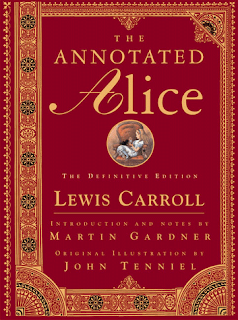
Here is a picture of my "Alice in Wonderland" I felt so connected to the Tartar book of fairytales, a feeling that you get from a book that delights and lets you in on all the minute details that may or may not matter to the book as a whole is nice, they are there for the taking yet aren't an integral part to the story; they remind me of the Tidbits. The Tidbits is a news column that has little 'tidbits' of information in them which is why, in the end I decided to buy The Annotated Alice. This fascination with tidbits, small facts of such minute information how could they hardly help or be interesting? Well I will tell you... they seem to open up your mind to endless possibilities. I feel myself scanning over them after I have read and interpreted a passage in whatever way my mind put the pieces together and the tidbits are almost a stepping stone to keep my thoughts, my ideas moving, sometimes they help and sometimes they hinder. These 'stepping stones' also remind me of Alice In Sunderland. Yet I have only made it a few short pages into this book it feels to take the same structure as this idea of 'stepping stones.' Except with Sunderland the 'stepping stones' are right in the text, no sidebar needed. It is like the idea of six degrees of seperation where the degrees are plotted for us and all it takes on our part are the 'steps.'

Monday, October 27, 2008
My Book and Heart Shall Never Part response

The most interesting thing of My Book and Heart Shall never Part for me was the cap the small child was made to wear that had a message on each of the three sides; one side said "It is fifty to one but you are," another said " I'll consider it," and the last said "I may be wrong." These sayings, usually put on a type of thinking cap was most notably written down in The History of Little Goody Two Shoes which is why it seems so relevent to the class. A cap and saying like this was eluded to in some Sherlock Holmes books I used to read as a child where Sherlock would settle down in his smoking jacket to consider difficult 'three-pipe' problems. It is fascinating to see a connection like this, where in my child hood I used to religiously read all of the Sherlock Holmes mysteries, I grow up to settle them in the back of my mind to collect dust, I take a class involved with children's literature wherein the professor of this course makes a movie that has a cap that Sherlock Holmes used or was used as a type of model for his and other peoples ways of figuring out problems.
notes for October 27th
Notes:
-chello music
--the serenity of music and how this serenity is often used as the music during the playing time. What types of music were used in the play of fairy tales?
-where words are impossible to describe?
=what world...
=What did she mean by that? Absolutely nothing, its music...
-Isaac Watts How doth the busy little bee
^-"Idleness was the devil's playground"
-- "How doth the Little Bee" is one of Isaac Watts's didactic poems for children that Lewis Carroll parodies in Alice in Wonderland:
How doth the little busy Bee
Improve each shining Hour,
And gather Honey all the day
From every opening Flower!
How skilfully she builds her Cell!
How neat she spreads the Wax!
And labours hard to store it well
With the sweet Food she makes.
In Works of Labour or of Skill
I would be busy too:
For Satan finds some Mischief still
For idle Hands to do.
In Books, or Work, or healthful Play
Let my first Years be past,
That I may give for every Day
Some good Account at last. [1715]
-Matrix is based on Alice in Wonderland
--make you be moral and busy
--eviscerate/disembowel
-My Book and Heart shall never part
--Plato's allegory of the cave
-if it can't be seen; deceive
--misplaced concreteness
--inadequate responses; questions still need to be asked
--wolf mask- boy behind mask- girl steals mask from boy
-- Children's lit. goes beyond the what is needful; all stories are portal stories...The subersion of child's lit.
--ironic- "a movie that teaches us that books aren't for teaching"
-chello music
--the serenity of music and how this serenity is often used as the music during the playing time. What types of music were used in the play of fairy tales?
-where words are impossible to describe?
=what world...
=What did she mean by that? Absolutely nothing, its music...
-Isaac Watts How doth the busy little bee
^-"Idleness was the devil's playground"
-- "How doth the Little Bee" is one of Isaac Watts's didactic poems for children that Lewis Carroll parodies in Alice in Wonderland:
How doth the little busy Bee
Improve each shining Hour,
And gather Honey all the day
From every opening Flower!
How skilfully she builds her Cell!
How neat she spreads the Wax!
And labours hard to store it well
With the sweet Food she makes.
In Works of Labour or of Skill
I would be busy too:
For Satan finds some Mischief still
For idle Hands to do.
In Books, or Work, or healthful Play
Let my first Years be past,
That I may give for every Day
Some good Account at last. [1715]
-Matrix is based on Alice in Wonderland
--make you be moral and busy
--eviscerate/disembowel
-My Book and Heart shall never part
--Plato's allegory of the cave
-if it can't be seen; deceive
--misplaced concreteness
--inadequate responses; questions still need to be asked
--wolf mask- boy behind mask- girl steals mask from boy
-- Children's lit. goes beyond the what is needful; all stories are portal stories...The subersion of child's lit.
--ironic- "a movie that teaches us that books aren't for teaching"
Sunday, October 26, 2008
The real 'morals'
Cinderella
The beautiful woman should take hast,
for coming upon them only hell will create.
Yet they believe beauty is the right path,
I am sorry to say, I only see rath.
The tale that is to be spun and pondered,
is tainted by the people who forever wonder.
Searching for beauty with sight only,
they will find this path very lonely.
And for the women who believe this,
who beautify themselves with out amiss.
You will find one day, the man with you,
is not a man, but only part of a selfish few.
Bluebeard
Oh, ye, with curiousness and charm,
you do no good, but only harm.
If this is a moral, then listen well,
since curiousity came from hell.
Your multi-tracked mind shouldn't wander,
for your husband is all you should ponder.
Through fire and brimstone, look ahead,
if you stray, I only see dread.
So to all you newly married wives,
I hope you have enjoyed your lives,
since now has the time come
for you to be content with dumb.
The beautiful woman should take hast,
for coming upon them only hell will create.
Yet they believe beauty is the right path,
I am sorry to say, I only see rath.
The tale that is to be spun and pondered,
is tainted by the people who forever wonder.
Searching for beauty with sight only,
they will find this path very lonely.
And for the women who believe this,
who beautify themselves with out amiss.
You will find one day, the man with you,
is not a man, but only part of a selfish few.
Bluebeard
Oh, ye, with curiousness and charm,
you do no good, but only harm.
If this is a moral, then listen well,
since curiousity came from hell.
Your multi-tracked mind shouldn't wander,
for your husband is all you should ponder.
Through fire and brimstone, look ahead,
if you stray, I only see dread.
So to all you newly married wives,
I hope you have enjoyed your lives,
since now has the time come
for you to be content with dumb.
Subscribe to:
Posts (Atom)

